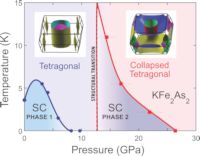
In collaboration with Dr. Jason Jeffries at Lawrence Livermore National Laboratory (LLNL), our team lead by Dr. Yasuyuki Nakajima has conducted a systematic study of the iron-pnictide superconductor KFe2As2 as a function of ultra-high pressures induced using a designer diamond anvil cell (DAC) technology developed at LLNL. By performing simultaneous low-temperature electrical resistivity and Hall effect measurements on high quality single-crystalline KFe2As2 up to applied pressures of 33 GPa, we have uncovered a sudden drastic three-fold enhancement of the superconducting transition temperature that occurs coincident with a first-order structural phase transition into a collapsed tetragonal phase near 13 GPa. Verified by a sudden reversal of dominant charge carrier sign, our band structure calculations suggest the high-temperature superconducting phase in KFe2As2 is substantially enhanced by the presence of nested electron and hole pockets, providing the key ingredient of high-Tc superconductivity in iron pnictide superconductors. This work is featured as an Editor's Suggestion in Physical Review B - Rapid Communications (see link here).
New High-Tc Superconducting Phase Discovered in KFe2As2